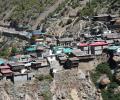
On August 5, 1953, Jawaharlal Nehru sent a strange note to the foreign secretary. It is worth mentioning because it was symptomatic of the lack of knowledge about Western Tibet in India and in South Block in particular, notes Claude Arpi.

'Nehru was an idealist, he was certainly a visionary in one way, but Mao Zedong was not. Mao Zedong was a very down-to-earth strategist. He wanted to take Tibet, to take the plateau, to take the rivers, to take the minerals.'

China is set to build a rail link connecting Xinjiang province with Tibet, part of which will run near the Line of Actual Control (LAC) with India.
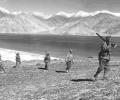
As India and China continue to face off across the Himalayas six decades later, the echoes of that earlier conflict remain unmistakable. The core of China's sensitivity lies not in maps or mountain passes, but in its perception of sovereignty over Tibet, points out Dr Kumar.
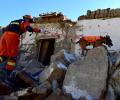
Local officials said no casualties have been reported due to Wednesday's quake that hit the Madoi County in Golog Tibetan Autonomous Prefecture of Qinghai province of northwest China at 3:44 pm (Beijing time), tremors for which were also felt in north-eastern Nepal.

The epicentre was located in Tsogo Township of Dingri County, which has a population of approximately 6,900 people within a 20-km radius. There are 27 villages within this area.
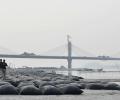
China has formally started the construction of a USD 167.8 billion dam over the Brahmaputra River in Tibet, close to the Indian border in Arunachal Pradesh, raising concerns in India and Bangladesh.

China on Friday operationalised its first fully electrified bullet train in the remote Himalayan region of Tibet, connecting the provincial capital Lhasa and Nyingchi, a strategically located Tibetan border town close to Arunachal Pradesh.

China has conducted a massive military exercise in the high altitude Qinghai-Tibet Plateau, close to the disputed borders with India, during which it has for the first time tested the multi-role J-10 fighter jets.
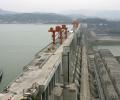
China defends its construction of a dam on the Brahmaputra river in Tibet, addressing concerns from India and Bangladesh about its potential impact on water flow and the environment.

On July 2 or July 6, the Dalai Lama will reveal his mind on his successor. This makes Beijing extremely nervous as the Communist regime fully realises the importance of controlling the next Dalai Lama, points out Claude Arpi.

China displayed a range of new weapons at a military parade, including laser weapons, nuclear ballistic missiles, giant underwater drones, and fifth-generation aircraft.
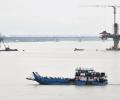
'China could intentionally release excess water.' 'The North East is already flood-prone during the monsoon, and even a controlled release from Chinese dams (during the monsoon) could worsen flooding.'

Xi commended the battalion members for their remarkable efforts in guarding China's border region, noting that they have dedicated their youth to securing the country's territorial integrity and have accomplished their missions well, state-run Xinhua news agency reported.
China has defended its plan to build the world's largest dam on the Brahmaputra River in Tibet, assuring that the project will not affect riparian states and safety issues have been addressed through decades of studies. The dam, estimated to cost USD 137 billion, has raised concerns in India and Bangladesh, but Chinese authorities maintain that the project has been thoroughly studied and safeguards are in place. The dam is part of China's efforts to develop clean energy and respond to climate change.
China has approved the construction of the world's largest dam on the Brahmaputra River in Tibet, close to the Indian border. The USD 137 billion project, which is expected to dwarf even China's own Three Gorges Dam, has raised concerns in India and Bangladesh, the downstream riparian states. Concerns in India are centered around China's potential to control water flow, potentially enabling the release of large amounts of water to flood border areas in times of hostilities. The dam is part of China's 14th Five-Year Plan, and the Chinese government claims that the project is safe and prioritizes ecological protection.

China is acutely conscious of the need for the next Dalai Lama to be under its control. It was for this reason that China recently stressed their claim on Arunachal Pradesh. There were rumours that the next Dalai Lama may be found in Tawang. If that happens, India-China relations will become tense and there may be demands for the child to be handed over to the Chinese, points out Ambassador T P Sreenivasan.

The seventh Tibet Work Forum was held in Beijing on August 28 and 29. Delhi should be deeply concerned, at a time India faces a precarious situation in Ladakh, because the TWF also defines China's western border policies, observes Claude Arpi.
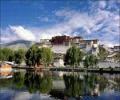
According to media reports the airport will be at an altitude of 4,436 meters.

The brigade that conducted the drills was from the PLA's Tibet Military Command and is one of China's two plateau mountain brigades.

Nearly two decades ago, then defence minister George Fernandes said: 'China has built roads up to the border, while there has been negligence on India's part.' Since Fernandes uttered these brave words, what has been done on the Indian side? The Modi Sarkar is apparently trying, but little has been achieved so far, says Claude Arpi.
The Sichuan-Tibet Railway will be the second railway line into Tibet after the Qinghai-Tibet Railway project. It will go through the southeast of the Qinghai-Tibet Plateau, one of the world's most geologically active areas, according to the Chinese official media.

'India should today tell China to provide proper facilities in Minsar for Indian yatris visiting Mt Kailash,' says Claude Arpi.
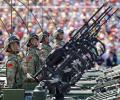
The move took place late last month and involved hardware being moved simultaneously by road and rail from across the entire region.

The new height is 86 cms more than the previous measurement.
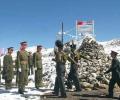
Suddenly the sands are shifting and even friends are acting strange.
Accusing China of creating "hell on earth" in Tibet by launching a "brutal crackdown," Tibetan spiritual leader, the Dalai Lama on Tuesday demanded "legitimate and meaningful" autonomy for the Himalayan plateau.
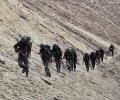
The government needs to answer the critical question of whether it has accepted any restrictions on its infrastructure creation activities, asserts Ajai Shukla.

The new rail and road cargo service launched on Friday, linking Guangdong, Tibet and Nepal, aims to boost trade with the South Asian neighbour as China pushes forward its Belt and Road (Silk Road) initiative, state-run Xinhua news agency reported on Saturday.
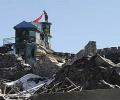
Public interest centres on whether the two leaders might make headway in resolving the Sino-Indian boundary dispute.

'The road from Zhangmu via Nyalam to Tingri is everything a Himalayan drive should be. With tall peaks as the backdrop, switchbacks yielding to roads that stretched into eternity, passing by some of the most scenic views on the planet.'

Since Tibet's occupation, China has disrupted the natural flow of rivers by pursuing a series of ill-conceived environmental and developmental policies such as the Great Leap Forward, the South-North Water Diversion Project, etc, the report said, adding that, this has led to a dam-building spree on the Tibetan plateau with disastrous impacts on Asia's major rivers.

'Is China's intention not clear?' 'Do we still think that if we are nice to China, it will be good to us?'
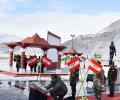
The Chinese authorities have been rapidly building defence infrastructure along the Line of Actual Control, indicating that they are preparing for a long period of tension with India, points out Jayadeva Ranade, the former senior RA&W officer and China expert.

Xi arrived at the Nyingchi Mainling Airport on Wednesday and was warmly welcomed by local people and officials of various ethnic groups, Xinhua news agency reported.

China plans to build a new highway along the Line of Actual Control (LAC) with India as part of Beijing's efforts to strengthen its strategic position and project its power, a media report said on Wednesday.

It is on the exact spot where the Guru is said to have created 108 waterfalls, that the Yangtse clash took place between the Indian Army and the Chinese PLA on the night of December 9, 2022. As it had done in Ladakh in May 2020, the PLA tried to change the unmarked LAC in the Yangtse sector in Arunachal Pradesh. It was the most serious border incident since the Galwan Valley clash in June 2020, notes Claude Arpi.

Although the special relationship might compel Bhutan to be considerate of Indian interests, new challenges will likely arise. An emerging new phase of relations will also call for fresh redlines between India and Bhutan, observe Harsh V Pant and Aditya Gowdara Shivamurthy.

'Intrusions by PLA troops in the Ladakh sector are more in number than elsewhere and this region is now likely to remain an area of enhanced Chinese interest,' warns China expert Jayadeva Ranade.
Important for India was Xi's meeting with representatives of PLA officers and soldiers stationed in Tibet. The video of the encounter was interesting to watch, especially the large number of lieutenant generals and major generals, observes Claude Arpi.
 © 2026 Rediff.com - Advertise with us - Disclaimer - Privacy Policy - Sitemap - Feedback - About us - Terms of use - Grievances